


Energy efficiency has undergone considerable change: while it was once a cost variable linked solely to the procurement of kilowatt-hours, it now intersects with more complex dynamics. From managing Corporate Social Responsibility (CSR) to complying with ESG criteria and considering the impact on human resources, energy efficiency now involves all these areas.
The structural vulnerabilities of industrial and commercial building assets are now well known. Most of these buildings were constructed at a time when priorities were not focused on thermal insulation or sustainability, favouring other aspects that now reveal evident critical issues when facing increasingly extreme climate conditions.
As we have also outlined in other content, companies have responded by replacing systems and installing increasingly powerful active air-conditioning systems (HVAC) on a large scale.
The limits of this approach are now evident from several perspectives: structural, economic and energy-related.
The change in perspective and the adoption of low-impact solutions also demonstrate that thermal comfort achieves objectives beyond improving the energy efficiency of an industrial and commercial building, supporting talent retention and helping to improve factors such as employer branding.
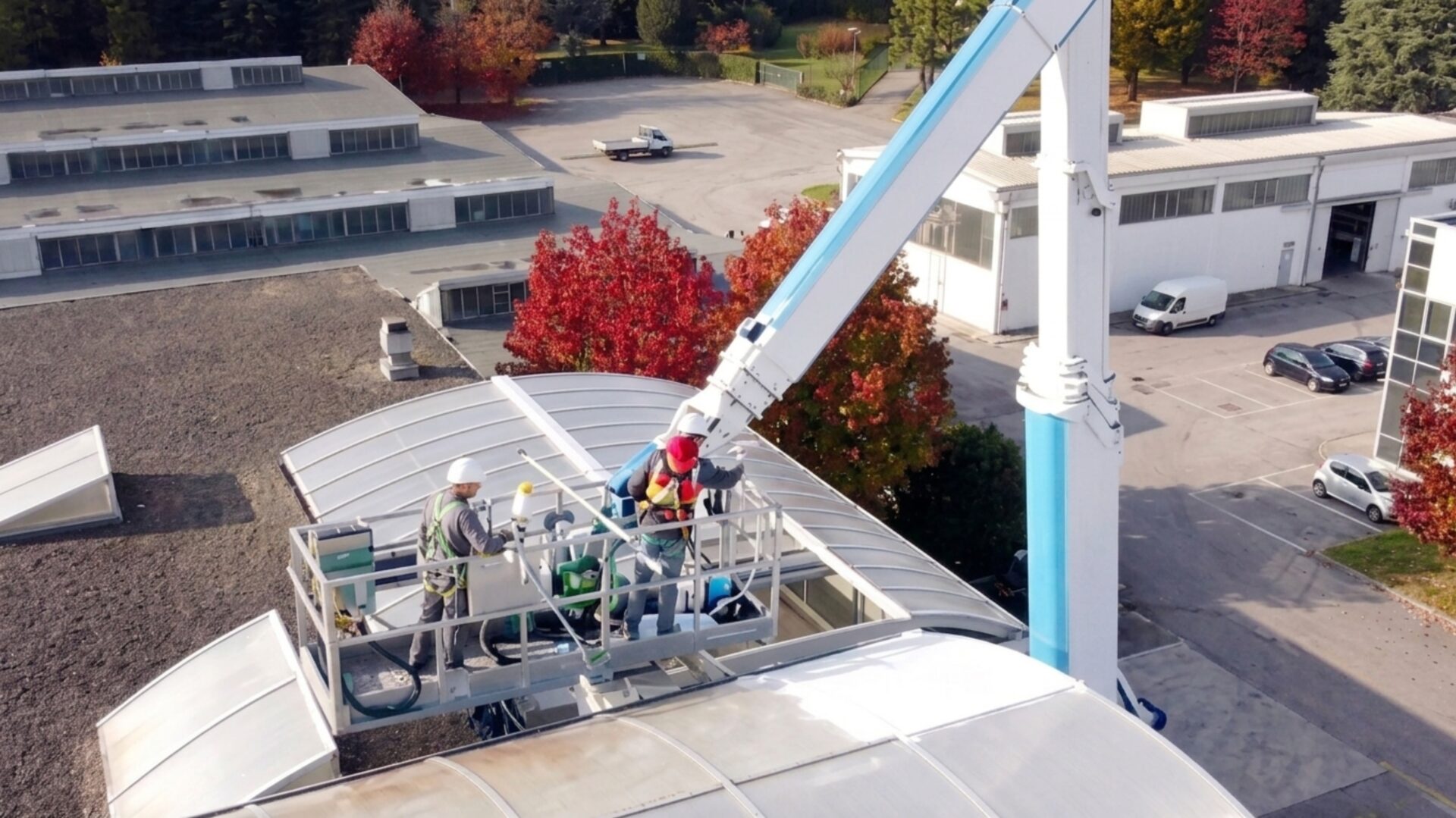
Table of contents
The limits of air conditioning as a single solution
The thermal control of large industrial volumes cannot be managed through air conditioning alone. For companies, accepting this fact is essential in order to reconsider their approach to the issue.
An air-conditioning system reduces heat and humidity inside an environment only after they have crossed the building envelope: attempting to cool monumental volumes of air becomes a titanic undertaking that can undermine the operational and economic stability of the entire company.
The decline in efficiency
Heat pumps, chillers and industrial refrigeration units generally use the Energy Efficiency Ratio (EER) parameter to measure their efficiency. This is a variable coefficient that depends on the thermal conditions near the condensers, namely the outdoor units.
With outdoor temperatures close to 40°C, the machines’ capacity for heat exchange decreases. This forces systems to increase energy consumption while achieving significantly lower cooling performance. The situation therefore becomes paradoxical: at the moment when maximum cooling effort is required, the air-conditioning system is operating at its lowest level of energy efficiency.
The economic and environmental impact
Uncontrolled air conditioning has a clear impact on electricity consumption, becoming an item that weighs heavily on corporate operating costs, but the negative results do not stop there.
The useful life of systems is reduced because wear occurs much more rapidly under extreme operating conditions. This requires frequent and costly extraordinary maintenance work.
As if that were not enough, from an environmental perspective, a situation such as the one described significantly increases direct carbon dioxide emissions. In addition, and with an even greater impact on ecosystems, there is the risk of micro-leaks from refrigerant gases within the systems.
Both situations contribute to making decarbonisation and sustainability goals increasingly distant, damaging the company’s environmental reputation in the market.
Thermal stress and the failure of welfare measures
However, the inefficiency of an air-conditioning system translates into an outcome that affects people as well as costs: the inability to create a suitable microclimate limits genuine well-being.
For a company where indoor spaces are intended for production, offices or any type of department used by employees, an environment in which systems introduce huge volumes of low-temperature air at high speed proves unhealthy.
Air currents, thermal stratification and continuous temperature fluctuations become sources of discomfort and real issues for staff.
The indoor microclimate of the workplace is directly responsible for the physical and emotional health and well-being of those who use it every day. For this reason, protecting it is important in order to provide better working quality.
The passive contribution of surfaces
To overturn the model that sees the replacement of active systems as the only possible response to energy efficiency, it is advisable to analyse the building envelope of commercial and industrial properties in order to study and remedy their critical points and weaknesses.
Solar radiation strikes the surfaces of a building, and the nature of those surfaces determines the effect of solar exposure. If a surface has no protection, radiant energy will be entirely absorbed by the materials and, in addition to raising the temperature of the surface itself, will also penetrate inside.
The critical points of the building envelope in industrial and commercial buildings
Overhead surfaces are the main source of heat accumulation in industrial and commercial buildings. Traditionally, roofs are covered with dark bituminous membranes that, from a performance perspective, have a high absorptance coefficient and minimal solar reflectance.
During the warmer months, the surface temperature can easily reach 80°C, and heat is transferred through conduction to the entire upper section, penetrating inside and contributing to the heating of machinery, flooring and people through direct radiation.
Similarly, skylights and glazing become thermal accelerators responsible for the greenhouse effect. By allowing solar radiation to enter freely, energy is absorbed by internal surfaces and released again, causing temperatures to rise.
Passive cooling and technologically advanced solutions available on the market act on the external optical and physical properties of building surfaces, reducing heat gain at its source.
ESG criteria: the economic impact of the “Social” component
Today, the quality of the workplace microclimate can also become a competitive factor in attracting and retaining specialised personnel. On the other hand, companies in which indoor environments present particularly difficult and challenging climatic conditions record an increase in voluntary resignations and summer absenteeism, and are frequently affected by higher staff turnover.
The environmental factor also proves to be a lever capable of attracting collaborators who share a commitment to sustainability.
The decision to invest in passive cooling therefore also represents an investment in human capital, helping to achieve objectives linked to ESG criteria.
The Serisolar model for an effective and sustainable intervention strategy
The complete elimination of active air conditioning is not the solution. On the contrary, the model Serisolar proposes to companies is based on synergy between devices for indoor temperature management, starting precisely with the improvement of the building envelope.
Serisolar’s consultancy focuses on the technical study of the energy audit in order to offer every company the most suitable response for the specific characteristics of its industrial and commercial building. Reducing thermal load and baseline energy demand also improves the performance of existing HVAC systems, avoiding their replacement and extending their useful life.
We offer companies certified and guaranteed passive solutions with a quick and non-invasive application process. As a strategic partner for the energy refurbishment of buildings, Serisolar is committed to supporting companies through a process that ensures measurable competitive and economic benefits.
If your company also wants to improve the quality of the indoor microclimate and the thermal management of industrial and commercial workspaces, while focusing on values such as ethical and reputational identity, contact us.